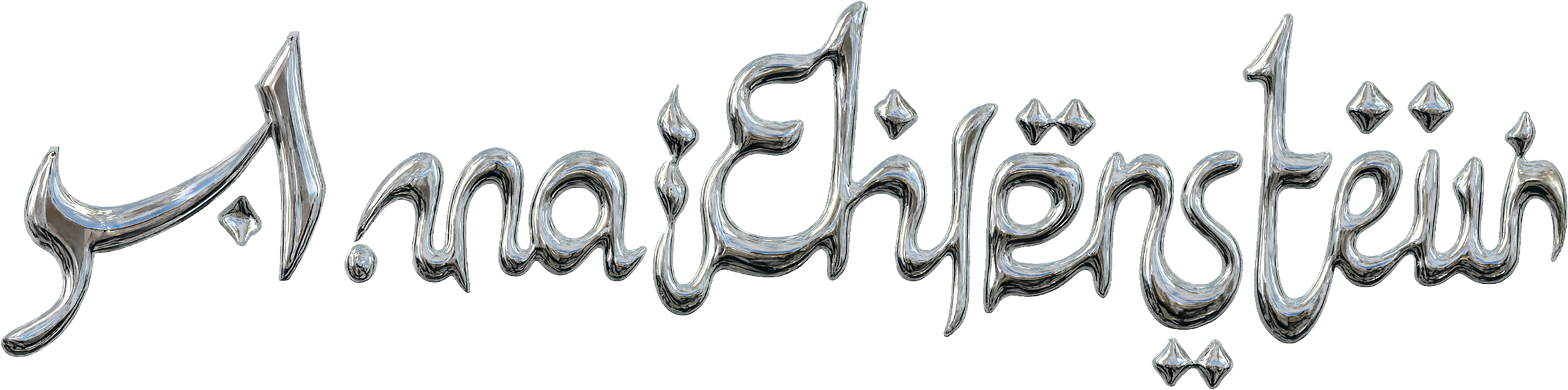
Anna Ehrenstein (b. 1993) is an interdisciplinary artist weaving multipolar cosmogony between Berlin, Tirana, and the cloud. She is a professor in the photography department at HGB Leipzig.
She adopts what she calls "a precarious assemblage" approach, collaborating extensively with diverse materials and groups, particularly through south-south collaborations as a way of redistributing global North resources. Ehrenstein’s work spans various printing methodologies combined with digital and physical painting, while sculptural forms of photography emerge in textile assemblages. Her art combines generative AI, 3D printing, and multiscreen or 360° video installations with ceramics, silicone, and epoxy sculptures.
Her practice is rooted in the fractures of a personal history: her father’s denied asylum in Germany, and her Turkish, Albanian and Egyptian heritage, which set her moving back and forth between Albania and Germany from an early age. These displacements shaped not only her sense of belonging but also her desire to research the necropolitics and material culture of migration—how lives are regulated through documents, infrastructures, and images, and how communities carve spaces of resilience within those systems. Alongside this, she explores Islamic science fiction and world-building as speculative frameworks for imagining repair and futurity. She understands critique as an act of love-making—and believes in the radical possibilities of spiritual coalition, performative ritual, neuroplasticity, collective unlearning, and constant renewal.
Her practice explores concepts of plasticity, mythology, Islamic and proto-science fiction, as well as critical theory and popular culture, examining how phenomena like generalization, exotification, or patronizing perspectives on certain cultural groups are embodied and transformed into corporeal qualities in analogue or virtual geographies, and how photographic legacies meander through virtual and physical realities.
In her textile practice, fabric is never merely surface—it is memory, migration, and metadata woven into form. LAN cables, silicone, hijabs from Tirana and Berlin, or talismanic embroidery become interfaces of ritual, speculation, and kinship. By activating textiles as both sensual and insurgent, she connects diasporic economies, counterfeit cultures, and digital networks into woven ecologies of memory, survival, and imagination. She often combines materials that don’t “belong” together—synthetic silks with silicone, embroidery threads with USB cables. These hybrids mirror diasporic realities: things patched, adapted, surviving. The materials themselves hold memory—silicone remembers heat, silk remembers touch, cables remember data transfer.
These are attempts to imagine repair not as nostalgia but as a techno-spiritual practice of co-creation. Various printing methodologies merge with digital and physical painting; sculptural forms of photography unfold in textile assemblages and through generative AI, 3D prints, multiscreen, or 360° video installations combined with ceramics, silicone, and epoxy.
She calls this approach “precarious assemblage”—a coming-together always close to falling apart: objects, images, and bodies leaning into one another without guarantee of permanence. It gestures toward the fragility of south–south trajectories and global dependencies, yet also toward the provisional possibilities of living otherwise.
Ehrenstein studied photography and pursued postgraduate studies in media arts in Germany, later expanding her curatorial training at the University of Malta and Lagos Biennial in Nigeria. In addition to her professorship at HGB Leipzig, she also teached at the Universität der Künste Berlin. Her work is represented by KOW and Office Impart in Berlin. A full CV is available upon request.